

2 chapters freeNo account needed.
Opens “A Mute Goes Aboard A Boat on the Mississippi” in the player · no sign-up needed
At sunrise on a first of April, there appeared, suddenly as Manco Capac at the lake Titicaca, a man in cream-colors, at the water-side in the city of St. Louis.
The work was published on the exact day of the novel's setting. Centered on the title character, The Confidence-Man portrays a group of steamboat passengers travelling on the Mississippi River toward New Orleans.
Inside the book
- Free nowno account · 2 chapters
- —Introduction4 min
- 1A Mute Goes Aboard A Boat on the Mississippi8 min
- Premium44 chapters · every book, 7 days free
- 2Showing That Many Men Have Many Minds5 min
- 3In Which A Variety of Characters Appear19 min
- 4Renewal of Old Acquaintance14 min
- 5The Man with the Weed Makes It an Even Question Whet...10 min
- 6At the Outset of Which Certain Passengers Prove Deaf...14 min
- 7A Gentleman with Gold Sleeve-Buttons18 min
- 8A Charitable Lady6 min
- 9Two Business Men Transact A Little Business12 min
- 10In the Cabin11 min
- 11Only A Page or So4 min
- 12Story of the Unfortunate Man, from Which May Be Gath...8 min
- 13The Man with the Traveling-Cap Evinces Much Humanity...11 min
- 14Worth the Consideration of Those to Whom It May Prov...6 min
- 15An Old Miser, upon Suitable Representations, Is Prev...11 min
- 16A Sick Man, After Some Impatience, Is Induced to Bec...17 min
- 17Towards the End of Which the Herb-Doctor Proves Hims...12 min
- 18Inquest into the True Character of the Herb-Doctor7 min
- 19A Soldier of Fortune18 min
- 20Reappearance of One Who May Be Remembered12 min
- 21A Hard Case18 min
- 22In the Polite Spirit of the Tusculan Disputations39 min
- 23In Which the Powerful Effect of Natural Scenery Is E...4 min
- 24A Philanthropist Undertakes to Convert A Misanthrope...19 min
- 25The Cosmopolitan Makes an Acquaintance10 min
- 26Containing the Metaphysics of Indian-Hating, Accordi...18 min
- 27Some Account of A Man of Questionable Morality, but...10 min
- 28Moot Points Touching the Late Colonel John Moredock8 min
- 29The Boon Companions16 min
- 30Opening with A Poetical Eulogy of the Press and Cont...30 min
- 31A Metamorphosis More Surprising Than Any in Ovid1 min
- 32Showing That the Age of Magic and Magicians Is Not Y...3 min
- 33Which May Pass for Whatever It May Prove to Be Worth3 min
- 34In Which the Cosmopolitan Tells the Story of the Gen...5 min
- 35In Which the Cosmopolitan Strikingly Evinces the Art...2 min
- 36In Which the Cosmopolitan Is Accosted by A Mystic, W...19 min
- 37The Mystical Master Introduces the Practical Disciple5 min
- 38The Disciple Unbends, and Consents to Act A Social Part4 min
- 39The Hypothetical Friends14 min
- 40In Which the Story of China Aster Is at Second-Hand...31 min
- 41Ending with A Rupture of the Hypothesis7 min
- 42Upon the Heel of the Last Scene the Cosmopolitan Ent...13 min
- 43Very Charming17 min
- 44In Which the Last Three Words of the Last Chapter Ar...4 min
- 45The Cosmopolitan Increases in Seriousness30 min
The opening
A Mute Goes Aboard A Boat on the Mississippi
A Mute Goes Aboard A Boat On The Mississippi.
At sunrise on a first of April, there appeared, suddenly as Manco Capac at the lake Titicaca, a man in cream-colors, at the water-side in the city of St. Louis.
His cheek was fair, his chin downy, his hair flaxen, his hat a white fur one, with a long fleecy nap. He had neither trunk, valise, carpet-bag, nor parcel. No porter followed him. He was unaccompanied by friends. From the shrugged shoulders, titters, whispers, wonderings of the crowd, it was plain that he was, in the extremest sense of the word, a stranger.
In the same moment with his advent, he stepped aboard the favorite steamer Fidèle, on the point of starting for New Orleans. Stared at, but unsaluted, with the air of one neither courting nor shunning regard, but evenly pursuing the path of duty, lead it through solitudes or cities, he held on his way along the lower deck until he chanced to come to a placard nigh the captain's office, offering a reward for the capture of a mysterious impostor, supposed to have recently arrived from the East; quite an original genius in his vocation, as would appear, though wherein his originality consisted was not clearly given; but what purported to be a careful description of his person followed.
As if it had been a theatre-bill, crowds were gathered about the announcement, and among them certain chevaliers, whose eyes, it was plain, were on the capitals, or, at least, earnestly seeking sight of them from behind intervening coats; but as for their fingers, they were enveloped in some myth; though, during a chance interval, one of these chevaliers somewhat showed his hand in purchasing from another chevalier, ex-officio a peddler of money-belts, one of his popular safe-guards, while another peddler, who was still another versatile chevalier, hawked, in the thick of the throng, the lives of Measan, the bandit of Ohio, Murrel, the pirate of the Mississippi, and the brothers Harpe, the Thugs of the Green River country, in Kentucky—creatures, with others of the sort, one and all exterminated at the time, and for the most part, like the hunted generations of wolves in the same regions, leaving comparatively few successors; which would seem cause for unalloyed gratulation, and is such to all except those who think that in new countries, where the wolves are killed off, the foxes increase.
Pausing at this spot, the stranger so far succeeded in threading his way, as at last to plant himself just beside the placard, when, producing a small slate and tracing some words upon if, he held it up before him on a level with the placard, so that they who read the one might read the other. The words were these:--
"Charity thinketh no evil."
As, in gaining his place, some little perseverance, not to say persistence, of a mildly inoffensive sort, had been unavoidable, it was not with the best relish that the crowd regarded his apparent intrusion; and upon a more attentive survey, perceiving no badge of authority about him, but rather something quite the contrary—he being of an aspect so singularly innocent; an aspect too, which they took to be somehow inappropriate to the time and place, and inclining to the notion that his writing was of much the same sort: in short, taking him for some strange kind of simpleton, harmless enough, would he keep to himself, but not wholly unobnoxious as an intruder—they made no scruple to jostle him aside; while one, less kind than the rest, or more of a wag, by an unobserved stroke, dexterously flattened down his fleecy hat upon his head. Without readjusting it, the stranger quietly turned, and writing anew upon the slate, again held it up:--
"Charity suffereth long, and is kind."
Illy pleased with his pertinacity, as they thought it, the crowd a second time thrust him aside, and not without epithets and some buffets, all of which were unresented. But, as if at last despairing of so difficult an adventure, wherein one, apparently a non-resistant, sought to impose his presence upon fighting characters, the stranger now moved slowly away, yet not before altering his writing to this:--
"Charity endureth all things."
Shield-like bearing his slate before him, amid stares and jeers he moved slowly up and down, at his turning points again changing his inscription to--
"Charity believeth all things."
and then--
"Charity never faileth."
The word charity, as originally traced, remained throughout uneffaced, not unlike the left-hand numeral of a printed date, otherwise left for convenience in blank.
To some observers, the singularity, if not lunacy, of the stranger was heightened by his muteness, and, perhaps also, by the contrast to his proceedings afforded in the actions—quite in the wonted and sensible order of things—of the barber of the boat, whose quarters, under a smoking-saloon, and over against a bar-room, was next door but two to the captain's office. As if the long, wide, covered deck, hereabouts built up on both sides with shop-like windowed spaces, were some Constantinople arcade or bazaar, where more than one trade is plied, this river barber, aproned and slippered, but rather crusty-looking for the moment, it may be from being newly out of bed, was throwing open his premises for the day, and suitably arranging the exterior. With business-like dispatch, having rattled down his shutters, and at a palm-tree angle set out in the iron fixture his little ornamental pole, and this without overmuch tenderness for the elbows and toes of the crowd, he concluded his operations by bidding people stand still more aside, when, jumping on a stool, he hung over his door, on the customary nail, a gaudy sort of illuminated pasteboard sign, skillfully executed by himself, gilt with the likeness of a razor elbowed in readiness to shave, and also, for the public benefit, with two words not unfrequently seen ashore gracing other shops besides barbers':--
"NO TRUST."
An inscription which, though in a sense not less intrusive than the contrasted ones of the stranger, did not, as it seemed, provoke any corresponding derision or surprise, much less indignation; and still less, to all appearances, did it gain for the inscriber the repute of being a simpleton.
Meanwhile, he with the slate continued moving slowly up and down, not without causing some stares to change into jeers, and some jeers into pushes, and some pushes into punches; when suddenly, in one of his turns, he was hailed from behind by two porters carrying a large trunk; but as the summons, though loud, was without effect, they accidentally or otherwise swung their burden against him, nearly overthrowing him; when, by a quick start, a peculiar inarticulate moan, and a pathetic telegraphing of his fingers, he involuntarily betrayed that he was not alone dumb, but also deaf.
Presently, as if not wholly unaffected by his reception thus far, he went forward, seating himself in a retired spot on the forecastle, nigh the foot of a ladder there leading to a deck above, up and down which ladder some of the boatmen, in discharge of their duties, were occasionally going.
From his betaking himself to this humble quarter, it was evident that, as a deck-passenger, the stranger, simple though he seemed, was not entirely ignorant of his place, though his taking a deck-passage might have been partly for convenience; as, from his having no luggage, it was probable that his destination was one of the small wayside landings within a few hours' sail. But, though he might not have a long way to go, yet he seemed already to have come from a very long distance.
Though neither soiled nor slovenly, his cream-colored suit had a tossed look, almost linty, as if, traveling night and day from some far country beyond the prairies, he had long been without the solace of a bed. His aspect was at once gentle and jaded, and, from the moment of seating himself, increasing in tired abstraction and dreaminess. Gradually overtaken by slumber, his flaxen head drooped, his whole lamb-like figure relaxed, and, half reclining against the ladder's foot, lay motionless, as some sugar-snow in March, which, softly stealing down over night, with its white placidity startles the brown farmer peering out from his threshold at daybreak.
About the author
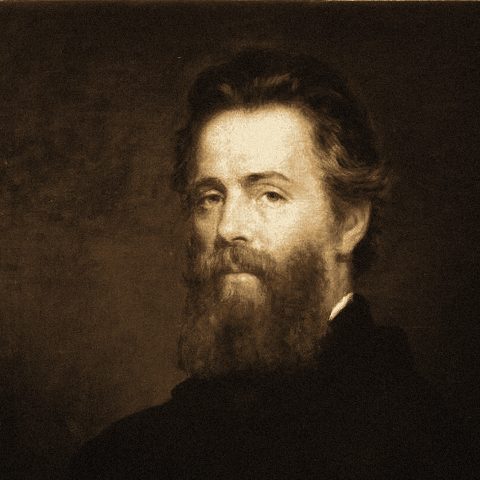
Herman Melville
1819 Manhattan – 1891 New York City · American writer and poet
Herman Melville was an American writer of the American Renaissance period. Among his best-known works are Moby-Dick (1851), Typee (1846), a romanticized account of his experiences in Polynesia, and Billy Budd, Sailor, a posthumously published novella.
- 1819Born, Manhattan
- 1846Typee
- 1851Moby Dick
- 1853Bartleby, the Scrivener
- 1891Died, New York City
More by Herman Melville
Keep going with Melville


If you like The Confidence-Man
More like this


Start with “A Mute Goes Aboard A Boat on the Mississippi”
2 chapters free right now — no account. Your place follows you to iPhone and Android.