

4 chapters freeNo account needed.
Opens chapter 4 in the player · no sign-up needed
Don Quixote is a novel by Miguel de Cervantes, written in Early Modern Spanish and published in two parts in 1605 and 1615. It is considered a founding work of Western literature and the first modern novel.
Inside the book
- Free nowno account · 4 chapters
- —Part 1 of 341 min
- —Part 2 of 340 min
- —Part 3 of 342 min
- 4Chapter 410 min
- Premium125 chapters · every book, 7 days free
- 5Chapter 511 min
- 6Chapter 612 min
- 7Chapter 713 min
- 8Chapter 88 min
- 9Chapter 914 min
- 10Chapter 1010 min
- 11Chapter 1115 min
- 12Chapter 1210 min
- 13Chapter 1310 min
- 14Chapter 1411 min
- 15Chapter 1512 min
- 16Chapter 1618 min
- 17Chapter 1715 min
- 18Chapter 1814 min
- 19Chapter 1914 min
- 20Chapter 2016 min
- 21Chapter 2120 min
- 22Chapter 2214 min
- 23Chapter 2326 min
- 24Chapter 2422 min
- 25Chapter 2521 min
- 26Chapter 2623 min
- 27Chapter 2717 min
- 28Chapter 2832 min
- 29Chapter 2915 min
- 30Chapter 3033 min
- 31Chapter 3129 min
- 32Chapter 3223 min
- 33Chapter 3320 min
- 34Chapter 3418 min
- 35Chapter 3513 min
- 36Chapter 3638 min
- 37Chapter 3738 min
- 38Chapter 3817 min
- 39Chapter 3919 min
- 40Chapter 4021 min
- 41Chapter 418 min
- 42Chapter 4216 min
- 43Chapter 4324 min
- 44Chapter 4439 min
- 45Chapter 4514 min
- 46Chapter 4619 min
- 47Chapter 4717 min
- 48Chapter 4815 min
- 49Chapter 4916 min
- 50Chapter 5020 min
- 51Chapter 5115 min
- 52Chapter 5214 min
- 53Chapter 5313 min
- 54Chapter 5410 min
- 55Chapter 5531 min
- 56Chapter 5622 min
- 57Chapter 579 min
- 58Chapter 5815 min
- 59Chapter 5910 min
- 60Chapter 6013 min
- 61Chapter 6111 min
- 62Chapter 6214 min
- 63Chapter 6314 min
- 64Chapter 647 min
- 65Chapter 6518 min
- 66Chapter 6612 min
- 67Chapter 6712 min
- 68Chapter 6812 min
- 69Chapter 6921 min
- 70Chapter 704 min
- 71Chapter 7119 min
- 72Chapter 7221 min
- 73Chapter 7316 min
- 74Chapter 7414 min
- 75Chapter 7517 min
- 76Chapter 7613 min
- 77Chapter 7715 min
- 78Chapter 7820 min
- 79Chapter 7912 min
- 80Chapter 8018 min
- 81Chapter 8116 min
- 82Chapter 8213 min
- 83Chapter 8310 min
- 84Chapter 8412 min
- 85Chapter 859 min
- 86Part 2, Chapter 31: Which Treats of Many and Great Matters16 min
- 87Chapter 8727 min
- 88Chapter 8814 min
- 89Chapter 8914 min
- 90Chapter 9014 min
- 91Chapter 9111 min
- 92Chapter 924 min
- 93Chapter 9312 min
- 94Chapter 945 min
- 95Chapter 9511 min
- 96Chapter 9620 min
- 97Chapter 9710 min
- 98Chapter 9812 min
- 99Chapter 9917 min
- 100Chapter 10014 min
- 101Chapter 1017 min
- 102Chapter 10216 min
- 103Chapter 10316 min
- 104Chapter 10422 min
- 105Chapter 10517 min
- 106Chapter 10616 min
- 107Chapter 10714 min
- 108Chapter 10811 min
- 109Chapter 10915 min
- 110Chapter 11014 min
- 111Chapter 11110 min
- 112Chapter 1127 min
- 113Chapter 11322 min
- 114Chapter 11416 min
- 115Chapter 11524 min
- 116Chapter 1165 min
- 117Chapter 11724 min
- 118Chapter 11819 min
- 119Chapter 1198 min
- 120Chapter 12010 min
- 121Chapter 12110 min
- 122Chapter 12210 min
- 123Chapter 12310 min
- 124Chapter 12410 min
- 125Chapter 12514 min
- 126Chapter 12611 min
- 127Chapter 1279 min
- 128Chapter 1289 min
- 129Chapter 12913 min
The opening
Chapter 4
In a village of La Mancha, the name of which I have no desire to call to mind, there lived not long since one of those gentlemen that keep a lance in the lance-rack, an old buckler, a lean hack, and a greyhound for coursing. An olla of rather more beef than mutton, a salad on most nights, scraps on Saturdays, lentils on Fridays, and a pigeon or so extra on Sundays, made away with three-quarters of his income. The rest of it went in a doublet of fine cloth and velvet breeches and shoes to match for holidays, while on week-days he made a brave figure in his best homespun. He had in his house a housekeeper past forty, a niece under twenty, and a lad for the field and market-place, who used to saddle the hack as well as handle the bill-hook. The age of this gentleman of ours was bordering on fifty; he was of a hardy habit, spare, gaunt-featured, a very early riser and a great sportsman. They will have it his surname was Quixada or Quesada (for here there is some difference of opinion among the authors who write on the subject), although from reasonable conjectures it seems plain that he was called Quexana. This, however, is of but little importance to our tale; it will be enough not to stray a hair's breadth from the truth in the telling of it.
You must know, then, that the above-named gentleman whenever he was at leisure (which was mostly all the year round) gave himself up to reading books of chivalry with such ardour and avidity that he almost entirely neglected the pursuit of his field-sports, and even the management of his property; and to such a pitch did his eagerness and infatuation go that he sold many an acre of tillageland to buy books of chivalry to read, and brought home as many of them as he could get. But of all there were none he liked so well as those of the famous Feliciano de Silva's composition, for their lucidity of style and complicated conceits were as pearls in his sight, particularly when in his reading he came upon courtships and cartels, where he often found passages like "the reason of the unreason with which my reason is afflicted so weakens my reason that with reason I murmur at your beauty;" or again, "the high heavens, that of your divinity divinely fortify you with the stars, render you deserving of the desert your greatness deserves." Over conceits of this sort the poor gentleman lost his wits, and used to lie awake striving to understand them and worm the meaning out of them; what Aristotle himself could not have made out or extracted had he come to life again for that special purpose. He was not at all easy about the wounds which Don Belianis gave and took, because it seemed to him that, great as were the surgeons who had cured him, he must have had his face and body covered all over with seams and scars. He commended, however, the author's way of ending his book with the promise of that interminable adventure, and many a time was he tempted to take up his pen and finish it properly as is there proposed, which no doubt he would have done, and made a successful piece of work of it too, had not greater and more absorbing thoughts prevented him.
Many an argument did he have with the curate of his village (a learned man, and a graduate of Siguenza) as to which had been the better knight, Palmerin of England or Amadis of Gaul. Master Nicholas, the village barber, however, used to say that neither of them came up to the Knight of Phœbus, and that if there was any that could compare with him it was Don Galaor, the brother of Amadis of Gaul, because he had a spirit that was equal to every occasion, and was no finikin knight, nor lachrymose like his brother, while in the matter of valour he was not a whit behind him. In short, he became so absorbed in his books that he spent his nights from sunset to sunrise, and his days from dawn to dark, poring over them; and what with little sleep and much reading his brains got so dry that he lost his wits. His fancy grew full of what he used to read about in his books, enchantments, quarrels, battles, challenges, wounds, wooings, loves, agonies, and all sorts of impossible nonsense; and it so possessed his mind that the whole fabric of invention and fancy he read of was true, that to him no history in the world had more reality in it.
He used to say the Cid Ruy Diaz was a very good knight, but that he was not to be compared with the Knight of the Burning Sword who with one back-stroke cut in half two fierce and monstrous giants. He thought more of Bernardo del Carpio because at Roncesvalles he slew Roland in spite of enchantments, availing himself of the artifice of Hercules when he strangled Antæus the son of Terra in his arms. He approved highly of the giant Morgante, because, although of the giant breed which is always arrogant and ill-conditioned, he alone was affable and well-bred. But above all he admired Reinaldos of Montalban, especially when he saw him sallying forth from his castle and robbing everyone he met, and when beyond the seas he stole that image of Mahomet which, as his history says, was entirely of gold. To have a bout of kicking at that traitor of a Ganelon he would have given his housekeeper, and his niece into the bargain.
In short, his wits being quite gone, he hit upon the strangest notion that ever madman in this world hit upon, and that was that he fancied it was right and requisite, as well for the support of his own honour as for the service of his country, that he should make a knight-errant of himself, roaming the world over in full armour and on horseback in quest of adventures, and putting in practice himself all that he had read of as being the usual practices of knights-errant; righting every kind of wrong, and exposing himself to peril and danger from which, in the issue, he was to reap eternal renown and fame. Already the poor man saw himself crowned by the might of his arm Emperor of Trebizond at least; and so, led away by the intense enjoyment he found in these pleasant fancies, he set himself forthwith to put his scheme into execution.
The first thing he did was to clean up some armour that had belonged to his great-grandfather, and had been for ages lying forgotten in a corner eaten with rust and covered with mildew. He scoured and polished it as best he could, but he perceived one great defect in it, that it had no closed helmet, nothing but a simple morion. This deficiency, however, his ingenuity supplied, for he contrived a kind of half-helmet of pasteboard which, fitted on to the morion, looked like a whole one. It is true that, in order to see if it was strong and fit to stand a cut, he drew his sword and gave it a couple of slashes, the first of which undid in an instant what had taken him a week to do. The ease with which he had knocked it to pieces disconcerted him somewhat, and to guard against that danger he set to work again, fixing bars of iron on the inside until he was satisfied with its strength; and then, not caring to try any more experiments with it, he passed it and adopted it as a helmet of the most perfect construction.
He next proceeded to inspect his hack, which, with more quartos than a real and more blemishes than the steed of Gonela, that "tantum pellis et ossa fuit," surpassed in his eyes the Bucephalus of Alexander or the Babieca of the Cid. Four days were spent in thinking what name to give him, because (as he said to himself) it was not right that a horse belonging to a knight so famous, and one with such merits of his own, should be without some distinctive name, and he strove to adapt it so as to indicate what he had been before belonging to a knight-errant, and what he then was; for it was only reasonable that, his master taking a new character, he should take a new name, and that it should be a distinguished and full-sounding one, befitting the new order and calling he was about to follow. And so, after having composed, struck out, rejected, added to, unmade, and remade a multitude of names out of his memory and fancy, he decided upon calling him Rocinante, a name, to his thinking, lofty, sonorous, and significant of his condition as a hack before he became what he now was, the first and foremost of all the hacks in the world.
Having got a name for his horse so much to his taste, he was anxious to get one for himself, and he was eight days more pondering over this point, till at last he made up his mind to call himself "Don Quixote," whence, as has been already said, the authors of this veracious history have inferred that his name must have been beyond a doubt Quixada, and not Quesada as others would have it. Recollecting, however, that the valiant Amadis was not content to call himself curtly Amadis and nothing more, but added the name of his kingdom and country to make it famous, and called himself Amadis of Gaul, he, like a good knight, resolved to add on the name of his, and to style himself Don Quixote of La Mancha, whereby, he considered, he described accurately his origin and country, and did honour to it in taking his surname from it.
So then, his armour being furbished, his morion turned into a helmet, his hack christened, and he himself confirmed, he came to the conclusion that nothing more was needed now but to look out for a lady to be in love with; for a knight-errant without love was like a tree without leaves or fruit, or a body without a soul. As he said to himself, "If, for my sins, or by my good fortune, I come across some giant hereabouts, a common occurrence with knights-errant, and overthrow him in one onslaught, or cleave him asunder to the waist, or, in short, vanquish and subdue him, will it not be well to have someone I may send him to as a present, that he may come in and fall on his knees before my sweet lady, and in a humble, submissive voice say, 'I am the giant Caraculiambro, lord of the island of Malindrania, vanquished in single combat by the never sufficiently extolled knight Don Quixote of La Mancha, who has commanded me to present myself before your Grace, that your Highness dispose of me at your pleasure'?" Oh, how our good gentleman enjoyed the delivery of this speech, especially when he had thought of someone to call his Lady! There was, so the story goes, in a village near his own a very good-looking farm-girl with whom he had been at one time in love, though, so far as is known, she never knew it nor gave a thought to the matter. Her name was Aldonza Lorenzo, and upon her he thought fit to confer the title of Lady of his Thoughts; and after some search for a name which should not be out of harmony with her own, and should suggest and indicate that of a princess and great lady, he decided upon calling her Dulcinea del Toboso—she being of El Toboso—a name, to his mind, musical, uncommon, and significant, like all those he had already bestowed upon himself and the things belonging to him.
About the author
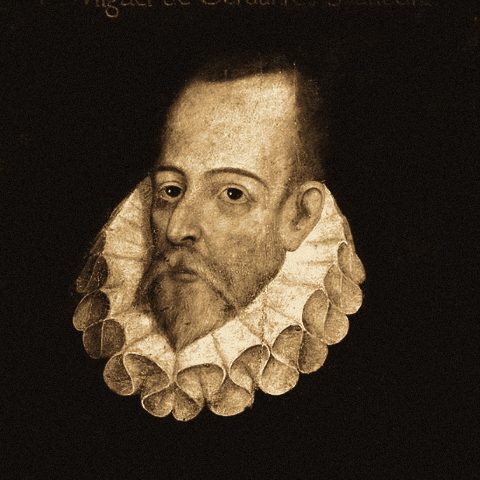
Miguel de Cervantes Saavedra
1547 Alcalá de Henares – 1616 Madrid · Spanish novelist, poet, and playwright
Miguel de Cervantes Saavedra was a Spanish writer widely regarded as the greatest writer in the Spanish language and one of the world's pre-eminent novelists. He is best known for his two-part novel Don Quixote, a work considered to be the first modern novel.
- 1547Born, Alcalá de Henares
- 1605Don Quixote
- 1616Died, Madrid
If you like Don Quixote
More like this


Start with chapter 4
4 chapters free right now — no account. Your place follows you to iPhone and Android.