

Chapter 1 freeNo account needed.
Opens “Along this particular stretch of line no express had...” in the player · no sign-up needed
Along this particular stretch of line no express had ever passed.
Though a social satire of its time, it is still appreciated and has been adapted to different media.
Inside the book
- Free nowno account · 1 chapter
- 1Along this particular stretch of line no express had...6 min
- Premium29 chapters · every book, 7 days free
- 2He took nobody by surprise; there was nobody to take12 min
- 3The terrace in front of the house was a long narrow...11 min
- 4Denis woke up next morning to find the sun shining...11 min
- 5Mr. Wimbush had taken them to see the sights of the...8 min
- 6Mr. Barbecue-Smith arrived in time for tea on Saturd...15 min
- 7At Crome all the beds were ancient hereditary pieces...9 min
- 8Breakfast on Sunday morning was an hour later than o...4 min
- 9Mr. Bodiham was sitting in his study at the Rectory17 min
- 10Denis did not dance, but when ragtime came squirting...6 min
- 11Mr. Barbecue-Smith was gone11 min
- 12Blight, Mildew, and Smut..." Mary was puzzled and di...10 min
- 13Henry Wimbush brought down with him to dinner a budg...30 min
- 14For their after-luncheon coffee the party generally...7 min
- 15In the time of the amiable Brantome," Mr7 min
- 16The ladies had left the room and the port was circul...6 min
- 17Ivor brought his hands down with a bang on to the fi...17 min
- 18The nearest Roman Catholic church was upwards of twe...7 min
- 19Henry Wimbush's long cigar burned aromatically29 min
- 20Ivor was gone. Lounging behind the wind-screen in hi...9 min
- 21Perched on its four stone mushrooms, the little gran...6 min
- 22For the sake of peace and quiet Denis had retired ea...16 min
- 23Gombauld was by no means so furious at their apparit...5 min
- 24It was noon. Denis, descending from his chamber, whe...11 min
- 25I hope you all realise," said Henry Wimbush during d...11 min
- 26A little canvas village of tents and booths had spru...5 min
- 27Mr. Scogan had been accommodated in a little canvas hut17 min
- 28Towards sunset the fair itself became quiescent9 min
- 29It was after ten o'clock9 min
- 30Denis had been called, but in spite of the parted cu...8 min
The opening
Along this particular stretch of line no express had...
Along this particular stretch of line no express had ever passed. All the trains—the few that there were—stopped at all the stations. Denis knew the names of those stations by heart. Bole, Tritton, Spavin Delawarr, Knipswich for Timpany, West Bowlby, and, finally, Camlet-on-the-Water. Camlet was where he always got out, leaving the train to creep indolently onward, goodness only knew whither, into the green heart of England.
They were snorting out of West Bowlby now. It was the next station, thank Heaven. Denis took his chattels off the rack and piled them neatly in the corner opposite his own. A futile proceeding. But one must have something to do. When he had finished, he sank back into his seat and closed his eyes. It was extremely hot.
Oh, this journey! It was two hours cut clean out of his life; two hours in which he might have done so much, so much—written the perfect poem, for example, or read the one illuminating book. Instead of which—his gorge rose at the smell of the dusty cushions against which he was leaning.
Two hours. One hundred and twenty minutes. Anything might be done in that time. Anything. Nothing. Oh, he had had hundreds of hours, and what had he done with them? Wasted them, spilt the precious minutes as though his reservoir were inexhaustible. Denis groaned in the spirit, condemned himself utterly with all his works. What right had he to sit in the sunshine, to occupy corner seats in third-class carriages, to be alive? None, none, none.
Misery and a nameless nostalgic distress possessed him. He was twenty-three, and oh! so agonizingly conscious of the fact.
The train came bumpingly to a halt. Here was Camlet at last. Denis jumped up, crammed his hat over his eyes, deranged his pile of baggage, leaned out of the window and shouted for a porter, seized a bag in either hand, and had to put them down again in order to open the door. When at last he had safely bundled himself and his baggage on to the platform, he ran up the train towards the van.
"A bicycle, a bicycle!" he said breathlessly to the guard. He felt himself a man of action. The guard paid no attention, but continued methodically to hand out, one by one, the packages labelled to Camlet. "A bicycle!" Denis repeated. "A green machine, cross-framed, name of Stone. S-T-O-N-E."
"All in good time, sir," said the guard soothingly. He was a large, stately man with a naval beard. One pictured him at home, drinking tea, surrounded by a numerous family. It was in that tone that he must have spoken to his children when they were tiresome. "All in good time, sir." Denis's man of action collapsed, punctured.
He left his luggage to be called for later, and pushed off on his bicycle. He always took his bicycle when he went into the country. It was part of the theory of exercise. One day one would get up at six o'clock and pedal away to Kenilworth, or Stratford-on-Avon—anywhere. And within a radius of twenty miles there were always Norman churches and Tudor mansions to be seen in the course of an afternoon's excursion. Somehow they never did get seen, but all the same it was nice to feel that the bicycle was there, and that one fine morning one really might get up at six.
Once at the top of the long hill which led up from Camlet station, he felt his spirits mounting. The world, he found, was good. The far-away blue hills, the harvests whitening on the slopes of the ridge along which his road led him, the treeless sky-lines that changed as he moved—yes, they were all good. He was overcome by the beauty of those deeply embayed combes, scooped in the flanks of the ridge beneath him. Curves, curves: he repeated the word slowly, trying as he did so to find some term in which to give expression to his appreciation. Curves—no, that was inadequate. He made a gesture with his hand, as though to scoop the achieved expression out of the air, and almost fell off his bicycle. What was the word to describe the curves of those little valleys? They were as fine as the lines of a human body, they were informed with the subtlety of art...
Galbe. That was a good word; but it was French. Le galbe evase de ses hanches: had one ever read a French novel in which that phrase didn't occur? Some day he would compile a dictionary for the use of novelists. Galbe, gonfle, goulu: parfum, peau, pervers, potele, pudeur: vertu, volupte.
But he really must find that word. Curves curves...Those little valleys had the lines of a cup moulded round a woman's breast; they seemed the dinted imprints of some huge divine body that had rested on these hills. Cumbrous locutions, these; but through them he seemed to be getting nearer to what he wanted. Dinted, dimpled, wimpled—his mind wandered down echoing corridors of assonance and alliteration ever further and further from the point. He was enamoured with the beauty of words.
Becoming once more aware of the outer world, he found himself on the crest of a descent. The road plunged down, steep and straight, into a considerable valley. There, on the opposite slope, a little higher up the valley, stood Crome, his destination. He put on his brakes; this view of Crome was pleasant to linger over. The facade with its three projecting towers rose precipitously from among the dark trees of the garden. The house basked in full sunlight; the old brick rosily glowed. How ripe and rich it was, how superbly mellow! And at the same time, how austere! The hill was becoming steeper and steeper; he was gaining speed in spite of his brakes. He loosed his grip of the levers, and in a moment was rushing headlong down. Five minutes later he was passing through the gate of the great courtyard. The front door stood hospitably open. He left his bicycle leaning against the wall and walked in. He would take them by surprise.
About the author
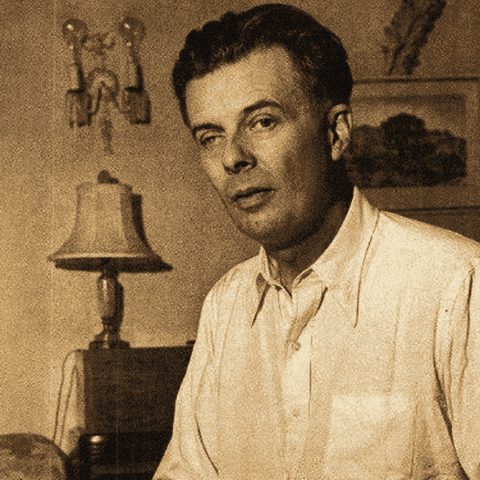
Aldous Huxley
1894 Godalming – 1963 Los Angeles
Aldous Leonard Huxley was an English writer and philosopher. His bibliography spans nearly 50 books, including non-fiction works, as well as essays, narratives and poems.
- 1894Born, Godalming
- 1921Crome Yellow
- 1923Antic Hay
- 1963Died, Los Angeles
If you like Crome Yellow
More like this


Start with “Along this particular stretch of line no express had...”
First chapter free right now — no account. Your place follows you to iPhone and Android.