

Chapter 1 freeNo account needed.
Opens “Dionysus” in the player · no sign-up needed
The Bacchae is an ancient Greek tragedy, written by the Athenian playwright Euripides during his final years in Macedonia, at the court of Archelaus I of Macedon.
Inside the book
- Free nowno account · 1 chapter
- 1Dionysus4 min
- Premium11 chapters · every book, 7 days free
- 2Chorus8 min
- 3Pentheus3 min
- 4Teiresias6 min
- 5Chorus10 min
- 6Chorus5 min
- 7Dionysus4 min
- 8Messenger13 min
- 9Chorus7 min
- 10Chorus4 min
- 11Messenger23 min
- 12Introductory Note21 min
The opening
Dionysus
Behold, God's Son is come unto this land Of Thebes, even I, Dionysus, whom the brand Of heaven's hot splendour lit to life, when she Who bore me, Cadmus' daughter Semele, Died here. So, changed in shape from God to man, I walk again by Dirce's streams and scan Ismenus' shore. There by the castle side I see her place, the Tomb of the Lightning's Bride, The wreck of smouldering chambers, and the great Faint wreaths of fire undying—as the hate Dies not, that Hera held for Semele. Aye, Cadmus hath done well; in purity He keeps this place apart, inviolate, His daughter's sanctuary; and I have set My green and clustered vines to robe it round. Far now behind me lies the golden ground Of Lydian and of Phrygian; far away The wide hot plains where Persian sunbeams play, The Bactrian war-holds, and the storm-oppressed Clime of the Mede, and Araby the Blest, And Asia all, that by the salt sea lies In proud embattled cities, motley-wise Of Hellene and Barbarian interwrought; And now I come to Hellas—having taught All the world else my dances and my rite Of mysteries, to show me in men's sight Manifest God.
And first of Hellene lands I cry thus Thebes to waken; set her hands To clasp my wand, mine ivied javelin, And round her shoulders hang my wild fawn-skin. For they have scorned me whom it least beseemed, Semele's sisters; mocked my birth, nor deemed That Dionysus sprang from Dian seed. My mother sinned, said they; and in her need, With Cadmus plotting, cloaked her human shame With the dread name of Zeus; for that the flame From heaven consumed her, seeing she lied to God. Thus must they vaunt; and therefore hath my rod On them first fallen, and stung them forth wild-eyed From empty chambers; the bare mountain side Is made their home, and all their hearts are flame. Yea, I have bound upon the necks of them The harness of my rites. And with them all The seed of womankind from hut and hall Of Thebes, hath this my magic goaded out. And there, with the old King's daughters, in a rout Confused, they make their dwelling-place between The roofless rocks and shadowy pine trees green.
Thus shall this Thebes, how sore soe'er it smart, Learn and forget not, till she crave her part In mine adoring; thus must I speak clear To save my mother's fame, and crown me here As true God, born by Semele to Zeus.
Now Cadmus yieldeth up his throne and use Of royal honour to his daughter's son Pentheus; who on my body hath begun A war with God. He thrusteth me away From due drink-offering, and, when men pray, My name entreats not. Therefore on his own Head and his people's shall my power be shown. Then to another land, when all things here Are well, must I fare onward, making clear My godhead's might. But should this Theban town Essay with wrath and battle to drag down My maids, lo, in their path myself shall be, And maniac armies battled after me! For this I veil my godhead with the wan Form of the things that die, and walk as Man.
O Brood of Tmolus o'er the wide world flown, O Lydian band, my chosen and mine own, Damsels uplifted o'er the orient deep To wander where I wander, and to sleep Where I sleep; up, and wake the old sweet sound, The clang that I and mystic Rhea found, The Timbrel of the Mountain! Gather all Thebes to your song round Pentheus' royal hall. I seek my new-made worshippers, to guide Their dances up Kithaeron's pine-clad side.
[As he departs, there comes stealing in from the left a band of fifteen Eastern Women, the light of the sunrise streaming upon their long white robes and ivy-bound hair. They wear fawn-skins over the robes, and carry some of them timbrels, some pipes and other instruments. Many bear the thyrsus, or sacred Wand, made of reed ringed with ivy. They enter stealthily till they see that the place is empty, and then begin their mystic song of worship.
About the author
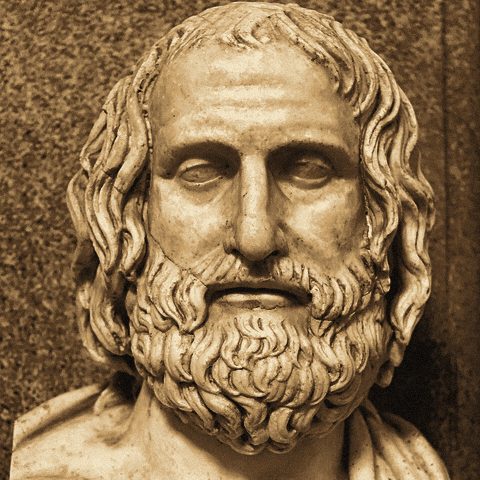
Euripides
Classical Athenian playwright
Euripides was a Greek tragedian of classical Athens. Along with Aeschylus and Sophocles, he is one of the three authors of Greek tragedy whose name is ascribed to surviving plays.
If you like The Bacchae of Euripides
More like this


Start with “Dionysus”
First chapter free right now — no account. Your place follows you to iPhone and Android.