

2 chapters freeNo account needed.
Opens “Book 1, Chapter 1: The Travelers” in the player · no sign-up needed
It was the opening of the season of eighteen hundred and thirty-two, at the Baths of Wildbad.
Armadale is a novel by Wilkie Collins, first serialised between November 1864 and June 1866, and then published in book form in 1866.
Inside the book
- Free nowno account · 2 chapters
- —Introduction1 min
- 2Book 1, Chapter 1: The Travelers13 min
- Premium50 chapters · every book, 7 days free
- 3Book 1, Chapter 2: The Solid Side of the Scotch Character16 min
- 4Chapter 436 min
- 5Chapter 539 min
- 6Chapter 642 min
- 7Chapter 745 min
- 8Book 3, Chapter 2: The Man Revealed53 min
- 9Book 3, Chapter 3: Day and Night37 min
- 10Book 3, Chapter 4: The Shadow of the Past42 min
- 11Book 3, Chapter 5: The Shadow of the Future33 min
- 12Book 4, Chapter 1: Lurking Mischief31 min
- 13Book 4, Chapter 2: Allan as A Landed Gentleman35 min
- 14Book 4, Chapter 3: The Claims of Society32 min
- 15Book 4, Chapter 4: The March of Events36 min
- 16Book 4, Chapter 5: Mother Oldershaw on Her Guard24 min
- 17Book 4, Chapter 6: Midwinter in Disguise18 min
- 18Book 4, Chapter 7: The Plot Thickens38 min
- 19Book 4, Chapter 8: The Norfolk Broads34 min
- 20Book 4, Chapter 9: Fate or Chance?29 min
- 21Book 4, Chapter 10: The House-Maid’s Face34 min
- 22Book 4, Chapter 11: Miss Gwilt Among the Quicksands25 min
- 23Book 4, Chapter 12: The Clouding of the Sky13 min
- 24Book 4, Chapter 13: Exit25 min
- 25Book 5, Chapter 1: Mrs. Milroy24 min
- 26Book 5, Chapter 2: The Man Is Found23 min
- 27Book 5, Chapter 3: The Brink of Discovery35 min
- 28Book 5, Chapter 4: Allan at Bay36 min
- 29Book 5, Chapter 5: Pedgift’s Remedy29 min
- 30Book 5, Chapter 6: Pedgift’s Postscript14 min
- 31Book 5, Chapter 7: The Martyrdom of Miss Gwilt38 min
- 32Book 5, Chapter 8: She Comes Between Them23 min
- 33Book 5, Chapter 9: She Knows the Truth55 min
- 34Book 5, Chapter 10: Miss Gwilt’s Diary (part 1)37 min
- 35Book 5, Chapter 10: Miss Gwilt’s Diary (part 2)40 min
- 36Book 5, Chapter 11: Love and Law22 min
- 37Book 5, Chapter 12: A Scandal at the Station19 min
- 38Book 5, Chapter 13: An Old Man’s Heart41 min
- 39Book 5, Chapter 14: Miss Gwilt’s Diary (part 1)37 min
- 40Book 5, Chapter 14: Miss Gwilt’s Diary (part 2)37 min
- 41Book 5, Chapter 15: The Wedding-Day (part 1)34 min
- 42Book 5, Chapter 15: The Wedding-Day (part 2)35 min
- 43Book 6, Chapter 1: Miss Gwilt’s Diary28 min
- 44Book 6, Chapter 2: The Diary Continued50 min
- 45Book 6, Chapter 3: The Diary Broken Off (part 1)45 min
- 46Book 6, Chapter 3: The Diary Broken Off (part 2)44 min
- 47Book 7, Chapter 1: At the Terminus14 min
- 48Book 7, Chapter 2: In the House23 min
- 49Book 7, Chapter 3: The Purple Flask (part 1)46 min
- 50Book 7, Chapter 3: The Purple Flask (part 2)47 min
- 51Book 8, Chapter 1: News from Norfolk12 min
- 52Book 8, Chapter 2: Midwinter4 min
The opening
Book 1, Chapter 1: The Travelers
It was the opening of the season of eighteen hundred and thirty-two, at the Baths of Wildbad.
The evening shadows were beginning to gather over the quiet little German town, and the diligence was expected every minute. Before the door of the principal inn, waiting the arrival of the first visitors of the year, were assembled the three notable personages of Wildbad, accompanied by their wives—the mayor, representing the inhabitants; the doctor, representing the waters; the landlord, representing his own establishment. Beyond this select circle, grouped snugly about the trim little square in front of the inn, appeared the towns-people in general, mixed here and there with the country people, in their quaint German costume, placidly expectant of the diligence—the men in short black jackets, tight black breeches, and three-cornered beaver hats; the women with their long light hair hanging in one thickly plaited tail behind them, and the waists of their short woolen gowns inserted modestly in the region of their shoulder-blades. Round the outer edge of the assemblage thus formed, flying detachments of plump white-headed children careered in perpetual motion; while, mysteriously apart from the rest of the inhabitants, the musicians of the Baths stood collected in one lost corner, waiting the appearance of the first visitors to play the first tune of the season in the form of a serenade. The light of a May evening was still bright on the tops of the great wooded hills watching high over the town on the right hand and the left; and the cool breeze that comes before sunset came keenly fragrant here with the balsamic odor of the first of the Black Forest.
"Mr. Landlord," said the mayor's wife (giving the landlord his title), "have you any foreign guests coming on this first day of the season?"
"Madame Mayoress," replied the landlord (returning the compliment), "I have two. They have written—the one by the hand of his servant, the other by his own hand apparently—to order their rooms; and they are from England, both, as I think by their names. If you ask me to pronounce those names, my tongue hesitates; if you ask me to spell them, here they are, letter by letter, first and second in their order as they come. First, a high-born stranger (by title Mister) who introduces himself in eight letters, A, r, m, a, d, a, l, e—and comes ill in his own carriage. Second, a high-born stranger (by title Mister also), who introduces himself in four letters—N, e, a, l—and comes ill in the diligence. His excellency of the eight letters writes to me (by his servant) in French; his excellency of the four letters writes to me in German. The rooms of both are ready. I know no more."
"Perhaps," suggested the mayor's wife, "Mr. Doctor has heard from one or both of these illustrious strangers?"
"From one only, Madam Mayoress; but not, strictly speaking, from the person himself. I have received a medical report of his excellency of the eight letters, and his case seems a bad one. God help him!"
"The diligence!" cried a child from the outskirts of the crowd.
The musicians seized their instruments, and silence fell on the whole community. From far away in the windings of the forest gorge, the ring of horses' bells came faintly clear through the evening stillness. Which carriage was approaching—the private carriage with Mr. Armadale, or the public carriage with Mr. Neal?
"Play, my friends!" cried the mayor to the musicians. "Public or private, here are the first sick people of the season. Let them find us cheerful."
The band played a lively dance tune, and the children in the square footed it merrily to the music. At the same moment, their elders near the inn door drew aside, and disclosed the first shadow of gloom that fell over the gayety and beauty of the scene. Through the opening made on either hand, a little procession of stout country girls advanced, each drawing after her an empty chair on wheels; each in waiting (and knitting while she waited) for the paralyzed wretches who came helpless by hundreds then—who come helpless by thousands now—to the waters of Wildbad for relief.
While the band played, while the children danced, while the buzz of many talkers deepened, while the strong young nurses of the coming cripples knitted impenetrably, a woman's insatiable curiosity about other women asserted itself in the mayor's wife. She drew the landlady aside, and whispered a question to her on the spot.
"A word more, ma'am," said the mayor's wife, "about the two strangers from England. Are their letters explicit? Have they got any ladies with them?"
"The one by the diligence—no," replied the landlady. "But the one by the private carriage—yes. He comes with a child; he comes with a nurse; and," concluded the landlady, skillfully keeping the main point of interest till the last, "he comes with a Wife."
The mayoress brightened; the doctoress (assisting at the conference) brightened; the landlady nodded significantly. In the minds of all three the same thought started into life at the same moment--"We shall see the Fashions!"
In a minute more, there was a sudden movement in the crowd; and a chorus of voices proclaimed that the travelers were at hand.
By this time the coming vehicle was in sight, and all further doubt was at an end. It was the diligence that now approached by the long street leading into the square—the diligence (in a dazzling new coat of yellow paint) that delivered the first visitors of the season at the inn door. Of the ten travelers released from the middle compartment and the back compartment of the carriage—all from various parts of Germany—three were lifted out helpless, and were placed in the chairs on wheels to be drawn to their lodgings in the town. The front compartment contained two passengers only—Mr. Neal and his traveling servant. With an arm on either side to assist him, the stranger (whose malady appeared to be locally confined to a lameness in one of his feet) succeeded in descending the steps of the carriage easily enough. While he steadied himself on the pavement by the help of his stick—looking not over-patiently toward the musicians who were serenading him with the waltz in "Der Freischutz"—his personal appearance rather damped the enthusiasm of the friendly little circle assembled to welcome him. He was a lean, tall, serious, middle-aged man, with a cold gray eye and a long upper lip, with overhanging eyebrows and high cheek-bones; a man who looked what he was—every inch a Scotchman.
"Where is the proprietor of this hotel?" he asked, speaking in the German language, with a fluent readiness of expression, and an icy coldness of manner. "Fetch the doctor," he continued, when the landlord had presented himself, "I want to see him immediately."
"I am here already, sir," said the doctor, advancing from the circle of friends, "and my services are entirely at your disposal."
"Thank you," said Mr. Neal, looking at the doctor, as the rest of us look at a dog when we have whistled and the dog has come. "I shall be glad to consult you to-morrow morning, at ten o'clock, about my own case. I only want to trouble you now with a message which I have undertaken to deliver. We overtook a traveling carriage on the road here with a gentleman in it—an Englishman, I believe—who appeared to be seriously ill. A lady who was with him begged me to see you immediately on my arrival, and to secure your professional assistance in removing the patient from the carriage. Their courier has met with an accident, and has been left behind on the road, and they are obliged to travel very slowly. If you are here in an hour, you will be here in time to receive them. That is the message. Who is this gentleman who appears to be anxious to speak to me? The mayor? If you wish to see my passport, sir, my servant will show it to you. No? You wish to welcome me to the place, and to offer your services? I am infinitely flattered. If you have any authority to shorten the performances of your town band, you would be doing me a kindness to exert it. My nerves are irritable, and I dislike music. Where is the landlord? No; I want to see my rooms. I don't want your arm; I can get upstairs with the help of my stick. Mr. Mayor and Mr. Doctor, we need not detain one another any longer. I wish you good-night."
Both mayor and doctor looked after the Scotchman as he limped upstairs, and shook their heads together in mute disapproval of him. The ladies, as usual, went a step further, and expressed their opinions openly in the plainest words. The case under consideration (so far as they were concerned) was the scandalous case of a man who had passed them over entirely without notice. Mrs. Mayor could only attribute such an outrage to the native ferocity of a savage. Mrs. Doctor took a stronger view still, and considered it as proceeding from the inbred brutality of a hog.
The hour of waiting for the traveling-carriage wore on, and the creeping night stole up the hillsides softly. One by one the stars appeared, and the first lights twinkled in the windows of the inn. As the darkness came, the last idlers deserted the square; as the darkness came, the mighty silence of the forest above flowed in on the valley, and strangely and suddenly hushed the lonely little town.
The hour of waiting wore out, and the figure of the doctor, walking backward and forward anxiously, was still the only living figure left in the square. Five minutes, ten minutes, twenty minutes, were counted out by the doctor's watch, before the first sound came through the night silence to warn him of the approaching carriage. Slowly it emerged into the square, at the walking pace of the horses, and drew up, as a hearse might have drawn up, at the door of the inn.
"Is the doctor here?" asked a woman's voice, speaking, out of the darkness of the carriage, in the French language.
"I am here, madam," replied the doctor, taking a light from the landlord's hand and opening the carriage door.
The first face that the light fell on was the face of the lady who had just spoken—a young, darkly beautiful woman, with the tears standing thick and bright in her eager black eyes. The second face revealed was the face of a shriveled old negress, sitting opposite the lady on the back seat. The third was the face of a little sleeping child in the negress's lap. With a quick gesture of impatience, the lady signed to the nurse to leave the carriage first with the child. "Pray take them out of the way," she said to the landlady; "pray take them to their room." She got out herself when her request had been complied with. Then the light fell clear for the first time on the further side of the carriage, and the fourth traveler was disclosed to view.
He lay helpless on a mattress, supported by a stretcher; his hair, long and disordered, under a black skull-cap; his eyes wide open, rolling to and fro ceaselessly anxious; the rest of his face as void of all expression of the character within him, and the thought within him, as if he had been dead. There was no looking at him now, and guessing what he might once have been. The leaden blank of his face met every question as to his age, his rank, his temper, and his looks which that face might once have answered, in impenetrable silence. Nothing spoke for him now but the shock that had struck him with the death-in-life of paralysis. The doctor's eye questioned his lower limbs, and Death-in-Life answered, I am here. The doctor's eye, rising attentively by way of his hands and arms, questioned upward and upward to the muscles round his mouth, and Death-in-Life answered, I am coming.
In the face of a calamity so unsparing and so dreadful, there was nothing to be said. The silent sympathy of help was all that could be offered to the woman who stood weeping at the carriage door.
As they bore him on his bed across the hall of the hotel, his wandering eyes encountered the face of his wife. They rested on her for a moment, and in that moment he spoke.
"The child?" he said in English, with a slow, thick, laboring articulation.
"The child is safe upstairs," she answered, faintly.
"My desk?"
"It is in my hands. Look! I won't trust it to anybody; I am taking care of it for you myself."
He closed his eyes for the first time after that answer, and said no more. Tenderly and skillfully he was carried up the stairs, with his wife on one side of him, and the doctor (ominously silent) on the other. The landlord and the servants following saw the door of his room open and close on him; heard the lady burst out crying hysterically as soon as she was alone with the doctor and the sick man; saw the doctor come out, half an hour later, with his ruddy face a shade paler than usual; pressed him eagerly for information, and received but one answer to all their inquiries--"Wait till I have seen him to-morrow. Ask me nothing to-night." They all knew the doctor's ways, and they augured ill when he left them hurriedly with that reply.
So the two first English visitors of the year came to the Baths of Wildbad in the season of eighteen hundred and thirty-two.
About the author
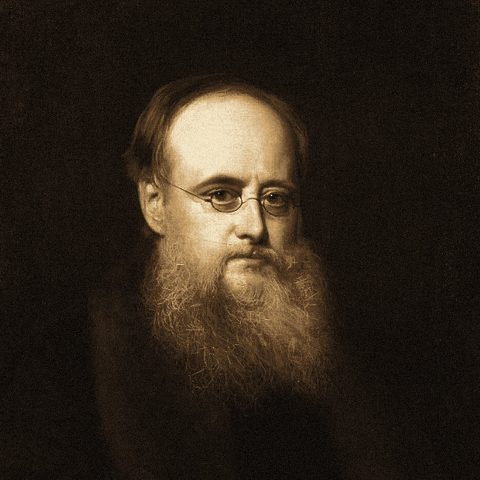
Wilkie Collins
1824 London – 1889 London · British writer
William Wilkie Collins was an English novelist and playwright known especially for The Woman in White (1860), a mystery novel and early sensation novel, and for The Moonstone (1868), which established many of the ground rules of the modern detective novel and is also perhaps the earliest clear example of the police procedural genre.
- 1824Born, London
- 1860The Woman in White
- 1862No Name
- 1866Armadale
- 1868The Moonstone
- 1875The Law and the Lady
- 1889Died, London
More by Wilkie Collins
Keep going with Collins


If you like Armadale
More like this


Start with “Book 1, Chapter 1: The Travelers”
2 chapters free right now — no account. Your place follows you to iPhone and Android.